There are dog shows and cat shows, but have you ever heard of a fish show? Goldfish fans from across the land compete each year to display the most sensational swimmer. It takes talent and planning to create the most pleasing arrangement of colorful scales. Can you win Best in Show with your finest fish?
In our season finale, two award winning games earn our Meeple Crown for 2023. These games embody the essence of Major Fun and our Spiel of Approval. Congratulations to Votes for Women and Thunder Road: Vendetta!
Thunder Road: Vendetta
Designers: Dave Chalker, Brett Myers
Additional Design/Development: Noah Cohen, Rob Daviau, Justin Jacobson, Jim Keifer, Brian Neff
D: Antoine Lefebvre A: Fanny Saulnier P: Randolph, Hachette Boardgames USA | BGG 2-4 players 30 min ages 8+ MSRP $15 Time to Teach/Learn: 3-4 min
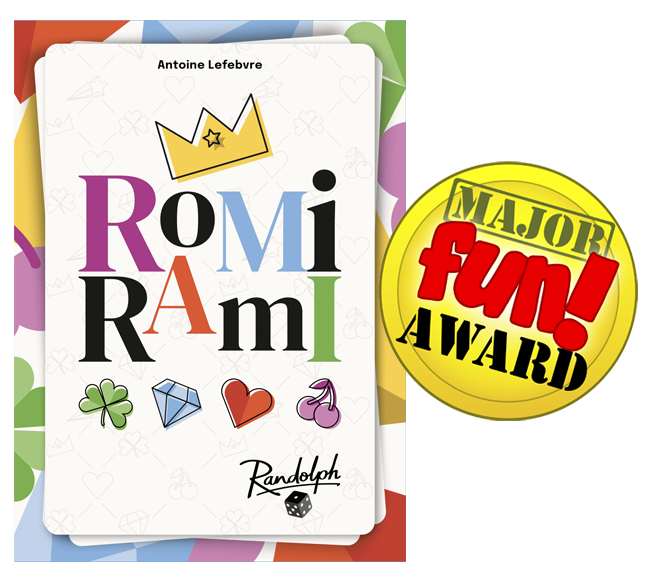
Romi Rami is a new game with an old soul. It has some famous card game cousins. You may have met them, Rummy and Contract Bridge, or its crazy board game uncle, Ticket to Ride. You’ll collect set of cards from one market in hopes of filling contracts from another. Keep your eyes peeled for the bonus suits and trophies, too. They can really boost your score.
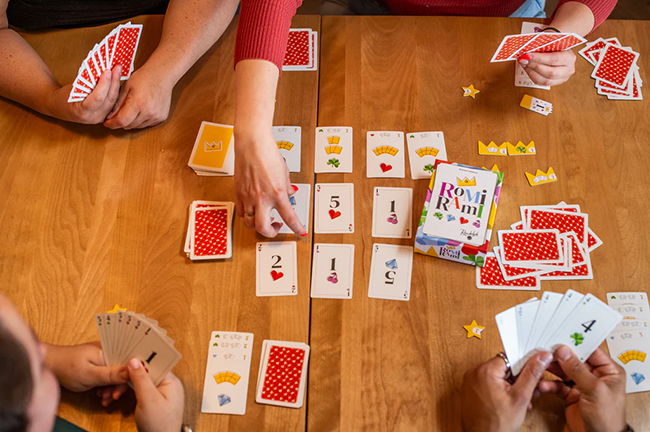
There are 128 cards in Romi Rami. The main deck has 92 cards in four different semi-traditional suits (hearts, diamonds, cherries, and clover). The cards are numbered 1-2-3-4-5 in each suit . There are four cards at the high and low end of each suit (Four 1 cards and four 5 cards). There are five cards for each number in the middle (Five 2s, 3s, and 4s).
The contract deck has 36 cards. These cards have four different elements.
In the center is a recipe of cards you will need in order to fill the contract. The recipe could show a set of like numbered cards (a pair, three, four or five of a kind) OR the recipe could show a sequence of consecutive numbered cards, a run (a three, four or five card run). Every contract will show at least one recipe or as many as three.
Below the recipe on each contract card is a bonus suit, a large icon matching one of the suits in the game: heart, diamond, cherry, or clover.
The top edge of each contract also has important information.
The top right corner of the card shows the number of points you will score for filling the contract.
The rest of the top of the card is the scoring zone: this area mirrors details about the contract so the cards can be stacked in columns and overlapped, solitaire style as you collect them. This way you dont have to see the whole card, just the scoring zone, once you collect it.
The scoring zone shows the bonus suit and a number of card combo icons that mirror the recipe(s) shown on the contract. So, for example, if a contract had two recipes – a pair and a 3 card run – and the bonus suit was clover, the scoring zone of that contract card would show a clover and two card combination icons: a 2 card combo and a 3 card combo.
There are 4 cardboard crowns which serve as trophies in the game. The crowns display a number of points and a different scoring requirement on each side.
There are four cardboard Joker tokens (stars). Each player gets one and has the option to use it once in the game.
To set up for a game of Romi Rami, shuffle the main deck and deal a three card hand to each player. Then use the main deck to create the number market in the center of the play area by dealing 6 cards face up (2 rows of three cards). Shuffle the contract deck and deal four contract cards face up to the play area just above the number market. Keep both main and contract decks handy as you’ll be dealing or drawing from them frequently during the game. Last but not least, toss the four trophy tokens in the air The trophy sides that land face up set the trophy scoring opportunities for the game. Grab a joker token, pick a start player and we’re ready to go.
The goal of Romi Rami is to score the most points. Each turn a player will perform three steps, then the next player in clockwise order will do the same and so on until a target number of contracts is filled based on the number of players. When this target is reached, finish the current game round so everyone has had an even number of turns, then count up your points and high score wins the game.
So here are the three steps to your turn in Romi Rami.
Step One: you MUST collect cards from the number market. You can collect up to three cards, never more than three! There are two rules to follow when you collect. All the cards you collect must be the same suit OR all the cards you collect must be the same number. You can always collect a single card of any suit or number. If you collect more than one card you have to follow these rules: all the same suit or all the same number.
Step Two: You MAY fill a contract (or contracts) from the market provided you have cards in your hand to fill the recipe or recipes listed on the contract. Fill one contract at a time and either discard or bank the cards used to fill the contract. We will get to banking cards in just a minute. Once you start filling contracts, stack them in a column solitaire style so the scoring zones for each contract are visible.
At any point you can use your Joker token as a wild card for any one missing card you need to fill a contract.
Step Three: Refill both markets so the number market has 6 cards and the contract market has four cards. Then, check the number of cards in your hand. If you have more than 10 cards, you must discard down to 10 cards. If you have less than 3 cards, draw cards from the main deck until you have 3.
So, you MUST collect cards from the number market (either matching suit or matching number) never more than 3 cards. Then you MAY fill contracts if you have the right combination of cards from your hand – discard or bank those cards. Last of all, refill the markets (number market should have 6 cards, contract should have 4). Check your hand size 10 is too many. Less than three refill your hand up to 3.
From there Romi Rami is lather rinse and repeat round after round until someone fills the target number of contracts (5 contracts for 4 players, 6 contracts for 3 players, 7 contracts for 2 players). When the game is over you will score the points listed for each contract you filled. You will get 1 bonus point if you didn’t use your Joker. And then you’ll score two additional ways: your banked bonus cards and trophies. These two methods are…
The suit bonus and trophy points make each decision of which cards to collect and which contracts to fill more involved and challenging.
Every contract has a suit bonus listed at the bottom of the card. To fill a contract you have to follow the recipe for the combinations listed in the middle of the card (sets of like number cards or runs of consecutive number cards). Suit never matters when filling contracts. Until it does! The suit bonus listed at the bottom of the card says this: for every card you use to fill this contract that matches the bonus suit, instead of discarding those cards when you fill the contract you get to BANK each of those matching suit cards into a score pile. At the end of the game, each card in your banked card pile is worth one point.
Suddenly the number market isnt just about numbers. You may choose collect cards of a certain suit from the market in hopes that you can fill a contract and bank the majority, maybe even ALL the cards you use because they match the suit bonus on the contract. And because all the contracts are public information, you need to keep an eye on not only what numbers others are collecting but what suits they take as well. You may have your heart set on a particular contract only to have it swept off the market by someone else because they could cash in on the suit bonus.
The trophy tokens list a point reward for the player who collects the most of something at the end of the game. It could be the most contracts with a certain suit; it could be the most 4 card combo shown in the scoring zone of your contracts. Suddenly each contract you fill could put you in competition with your neighbors for the most diamonds or the most pairs. In order to win the trophy there can be no tie. You have to have an outright majority. As the game charges closer and closer to the end (and the end will sneak up on you much faster than you think) you will want to keep close tabs on where you stand in the trophy race since it could easily influence which contract you choose to fill.
Romi Rami is a great example of a modern grandma game. I know this is an inherently silly term, but hear me out. A grandma game doesnt mean you can only play it with grandma. It means you can play it with everyone including grandma (or grandpa). It means it is a game with a timeless quality, a universal appeal, a game you can pull of the shelf and teach grandma or anyone younger than grandma (or grandpa) and they will be able to absorb the rules and have fun on a level playing field.
A grandma game is a triumph of accessibility. If grandma can play and enjoy Romi Rami, I think practically anyone can. It is HARD to create games that have this broad appeal that aren’t just retreads of older games. Familiarity with key concepts and rules are often what make a game accessible, but it can also make it boring. You can draw inspiration from your cousins, but you dont want to clone them! Romi Rami can trace its heritage back to set collecting and contract filling games. You can even see how filling and scoring tickets building your train routes card by card shares some DNA with this game. Romi Rami draws great inspiration from its heritage, but also stands apart with its own paths to challenge and enjoyment. This vaults Romi Rami into its own class of classic, major fun for all.
Movie Night! You and your friends have gathered to enjoy a flick at the cineplex. But which one? Can you find one you will all agree to watch?
You scan the listings and realize you don’t know any of these films. Rebel Panda? Kung Fu Soup? Duck Without a Cause?? What are these movies?
Fortunately, you can always rely on the two critics: Polly Positive, and The Grumpy Guy. And look, they reviewed the same movie!
But which movie is it? Somehow, the title of the movie is missing from their reviews. It’s not clear which picture they are both talking about.
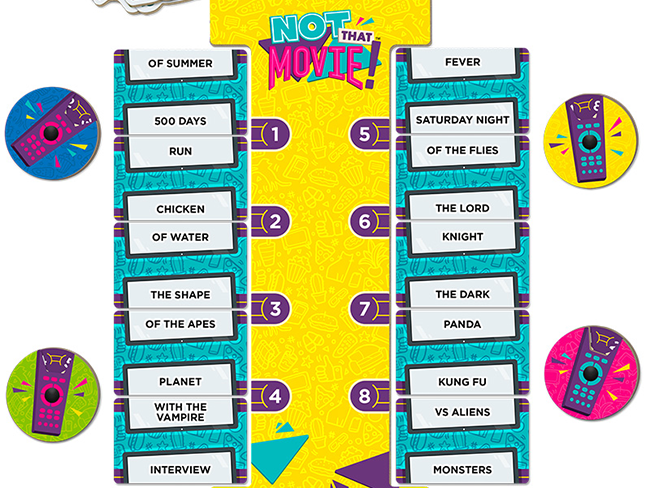
Is it Interview In the Hat? The Cat Alone?? Maybe Home with the Vampire?
Guided by the reviews, each of you tries to sort it out by process of elimination. Only one movie at the cineplex can be THE ONE. The rest, clearly, are Not That Movie!
***
Not That Movie is a cooperative Party game. Each round, players work together to determine which mixed up movie title the critics have described through process of elimination.
At the end of 5 rounds, are you an epic flop or worthy of an Academy Award?
Steam Up is a restaurant known for its sumptuous servings of Dim Sum. Magical creatures come to sample the best bite-size gourmet dishes from bamboo baskets stacked high. Luckily, each animal arrives with an appetite and an agenda for their ideal meal. May the fullest stomach win!
The goal of Steam Up is to collect Hearty Points. You do this by eating dim sum from steamer baskets you rotate to your part of the table. Track the dishes on your board and score according to the rules for your animal. But watch out! Fate and Fortune will play a part in each meal as well.
Listen in to explore the game and discover why Steam Up is a feast for anyone with a hankering for Major Fun!
Steam Up: A Feast of Dim Sum
D: Pauline Kong, Marie Wong, Haymen Lee A: Tim Cheng, Grace Tjahyadi, YDXArt P: Hot Banana Games | BGG Link 2-5 players 45 minutes ages 8+ MSRP $49
This road is freedom. This road is escape. But only for one. For the rest it is ruin!
There are no rest stops. Hard charging waves of mayhem and destruction push you ever-forward, never sure what lies beyond the horizon. You must keep rolling.
This road calls to you – its voice, the sound of furious thunder.
Thunder Road: Vendetta is a reboot of a beloved roll and move car crashing game from the 1980s. Each player starts with 3 vehicles and a chopper. Who will survive this perilous race down Route Sixty Styx?
Thunder Road: Vendetta
Designers: Dave Chalker, Brett Myers
Additional Design/Development: Noah Cohen, Rob Daviau, Justin Jacobson, Jim Keifer, Brian Neff
The game poses three puzzles to each of its players. Can you create patterns of matching symbols to meet your goals? You and your opponents will fill an increasingly crowded common board with an ever-changing array of tiles, rotating and shifting them – creating opportunities for some and challenges for others.
Listen in to explore Four Corners and learn why we think its sneaky sideways tactics are most certainly Major Fun.
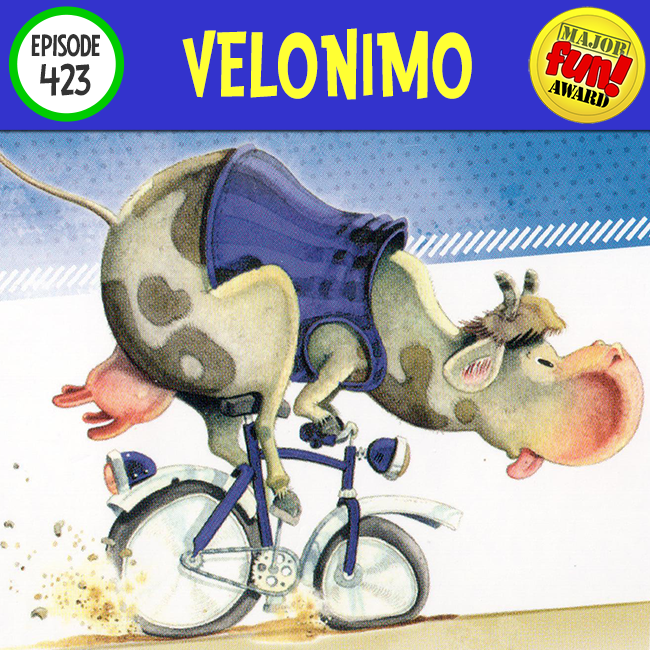
Humans have the Tour de France. Animals have the Tour de Zoo! A menagerie of animal cyclists from around the world have come to test their mettle with their pedals! Five mountain summits stand between you and the coveted Leader of the Pack jersey.
Velonimo is a modern twist on two classic card game elements: climbing and card shedding. The goal is to get rid of all your cards. You’ll do this by playing a card or combinations of cards that are higher than the ones previously played. Velonimo is five races up five mountains, each higher than the next. The first player to shed their hand in a round, finishes in first place and gets the leader’s jersey.
Velonimo allows players to combine cards across color or number. It also introduces powerful single cards – some with special abilities (the tortoise) and some with very high values (the hare). This means you have many different ways to stay in the race.
Strap on your helmet and tune in. Before you know it, you’ll be at the summit, riding along side Major Fun.
Designers: Cory O’Brien Artist: Matthew Inman Publisher: Exploding Kittens 3-7 players 15 min ages 7+ MSRP $26 Time to Teach/Learn: 3 minutes Written by: Stephen Conway
No one knows why wombats enjoy architecture. A desire to build towers is buried deep in their bones. But there are exceptions, wicked wombats, born to make trouble. Hand to Hand Wombat pits a team of builders against fuzzy little secret sowers of chaos. The builders must stack pieces to create three towers, while the bad wombat works to sabotage them without getting caught. This might seem easy or impossible depending on what team you’re on, until you discover the twist. Everyone plays with their eyes closed!
The entire game takes place within the confines of the box lid.
In it, you’ll place all the pieces needed to complete three towers. Each tower has a spindle and six nubbly square pieces. The pieces have holes in the center, allowing them to slide onto the spindles. The piece with 6 nubs along its edges is the base of the tower. The five nub piece stacks nicely above it and so on.
To play, deal out wombat cards to see who is on the builder team and who is the wicked wombat. Do not share your identity with anyone else! Place all the tower pieces and the spindles in the box lid and you’re ready to go.
The goal in Hand to Hand Wombat is to complete towers if you are a builder, or to keep towers from being built if you are wicked.
Each game round is 90 seconds, plus a vote. When the timer starts, everyone closes their eyes (no peeking!). Builder Wombats try to assemble the three towers, using one hand only, placing the widest piece of each tower at the base (the six nub piece), then the five and so on. You can communicate with everyone at the table. You can pass pieces to each other. You can even place your hand over a spindle to prevent others from messing with it. You can never take pieces out of the box to sort or save them.
While the Builders are building, the Wicked Wombat is trying to screw things up. You must be subtle, though! If you’re too obvious, you’ll get caught. You might give someone the wrong piece, or place a piece on a spindle out of order. You might even rotate the box lid! Even TALKING REALLY LOUDLY could be enough to throw things off.
At the end of the round, all players vote on who they think the wicked wombat is. If one player has more than half the votes, that player is out! That player does not reveal their identity and the game continues. Reset the timer and the goal is the same. Build towers or cause trouble.
Each round, one team scores. The builders must get at least two towers built to score one point. If they build all three, they score two points. If only one tower is built, the wicked wombat scores one point. If no towers are complete, the sneaky side gets two points. First team to score three points wins the game.
A subtle but important note: the wicked wombat can win even if they have been voted out, since the builders won’t know they have discovered the traitor! The Builders have to complete 2 towers each round or the wicked wombat still scores points. The Wicked Wombat will cackle with glee if they win because the builders didn’t trust each other.
It is hard to think of another game that combines such disparate elements: cooperative stacking paired with a traitor. By all rights this game could be a hot mess. And yet, this marriage works! Playing blind with just the right amount of time pressure balances everything. Even without a player trying to wreck things, getting a group of people to work together without sight to build three simple towers takes an incredible amount of teamwork and communication. The traitor certainly needs to play a role in creating chaos, but the clock and the cloak of darkness allow each side to figure out a way to play that works best for them.
Hand to Hand Wombat is a hilarious invitation to play. Teamwork based on touch and talking and trust is a challenge you’ll almost certainly stumble through the first few rounds. And therein lies one kind of fun. You can’t take yourself too seriously in order to find a way to accomplish this ridiculous task. If you’re wicked, trying to listen and literally feel your way through the game to find ways to subtlety wreck everyone else’s plans is a deliciously fiendish kind of fun. But wait, there’s more. Hand to Hand Wombat yearns for an audience. It is play as a form of performance. It’s hard to argue that any onlookers might have even more fun watching than the goofballs playing the game!
Designers: Patrick Rauland Artist: Shirley Gong Publisher: Left Justified Studio | BGG Entry 2-4 players 15 min ages 12+ MSRP $16 Time to Teach/Learn: 5 minutes Written by: Doug Richardson
Broken and Beautiful honors the art of Kintsugi, where broken pottery is repaired with golden lacquer. In Kintsugi, breakage and repair are beautiful facets of an object’s unique history. In the game, you’ll draft pottery cards, manage their breakage, and repair them to increase their value.
Broken and Beautiful is played with a deck of 46 game cards. These represent pottery, gold, serving trays, and storage boxes, commonly found in many Japanese homes. Both sides of the pottery cards are important in the game. One side shows the unbroken object; the other side shows the repaired side, with golden veins connecting the broken pieces.
The cards also have an icon which tells you what class of goods it depicts: cup, saucer, plate, bowl, tea jar, vase, teapot, serving tray, or storage box.
Each card shows a number of gold ingots in the lower left corner. This is the cost to repair the item, should it break.
In addition, there are 4 player reference cards, 14 gold ingots made of wood, and a First Player marker.
To set up a game of Broken and Beautiful, you’ll orient the cards unbroken side up, and give them a shuffle.
Pick a start player for the first round. The player who most recently washed the dishes would be a fitting choice.
Now deal a group of pottery cards to the table equal to two times the player count, plus one. In a 3 player game, this would be 7 cards.
(Hint: It is helpful to lay out the pottery cards each round with like items grouped together. This way, everyone can clearly see how many of each are available.)
Now you’re ready to play Broken and Beautiful.
In Broken and Beautiful, you choose pottery cards to keep as part of your collection or to sell. Then certain pottery cards will break and players will have an opportunity to repair them, provided they can pay enough gold. Each type of pottery scores in a different way and this score can be enhanced if pottery is repaired. The goal to amass the most beautiful collection of pottery and score the most points
Broken and Beautiful follows a simple four-step round structure:
1)Prepare for the Draft 2)Draft Cards 3)Pottery Breaks 4)Repairing Pottery
During the draft, each player will select two cards. The start player selects one card, followed by the player to the left
When you select a card, you have two options. Either you put the card in your collection, or you sell the card for gold. If you put the card in your collection, place the card, unbroken side up, in front of you on the table. If you sell the card, take the number of ingots shown on the lower left corner of the card.
Once the last player takes a card, the order of play reverses. The last player selects their second card, followed by the player to the right, and ending with the start player. In game terms, this is known as a snake draft.
After each player has taken two cards, one card will remain unchosen. This card and the card on top of the draw deck will determine which pieces will break.
Remember both sides of the cards are significant in Broken & Beautiful. The top of the draw deck will display a piece of pottery, just like the card that was not chosen.
If a cup and a bowl are the remaining two cards, then all cups and all bowls in every player’s collection will break. Turn these cards sideways to show they are now broken.
But don’t despair! The game is all about celebrating the repair of everyday objects and making them more beautiful.
Starting with the first player, each player may repair an item. The cost to repair your first item is shown in ingots on the card. A broken cup may be repaired by paying one gold, for example. Simply return that ingot to the general supply, and flip the card to its repaired side.
When you do, you’ll notice the repaired cup is now worth more points than before. On its normal side, a cup was worth one point. Broken, it is worth nothing. But when you repair it, it now is worth 3 points. It has become both broken and beautiful–and more valuable!!
After all players have had a chance to repair their first broken item, everyone has a chance to repair a second item, but the cost goes up! Repairing your second item costs one gold more than the price listed on the card. Your third repair costs 2 gold more and so on.
When all repairs are done, pass the start player marker to the next player in turn order, and set up for another round. The game ends when you can no longer deal out enough cards to hold another draft.
Now everyone will total up the points for their collection. Each item scores in its own unique way.
Cups score one point.
Saucers score nothing on their own, but when paired with a cup, double the cup’s worth.
Plates are worth 6 points,but only if you have a pair of them. A single plate scores no points.
Bowls are worth the number of them in your collection. That is, if you have 3 bowls, they are each worth 3 points apiece.
Tea jars will score you 6 points, but only if you have the most tea jars.
Vases are worth 1 point if you have just one, 5 points for two. Collect all three, and you get 15 points.
Teapots are worth as many points as you have other pottery with a matching pattern.
Finally, there are the wooden storage trays and storage boxes. Trays just score 2 points. Storage boxes are worth as many points as you have left over gold.
But that’s only half the story. The scoring for every item is enhanced when they are repaired. For example, pair a regular cup and saucer, and you’ll score 3 points. But if both have been repaired, the cup is now worth 3, and the saucer triples that to 9 points.
The key concept is that every object has value, but repaired objects enable new or enhanced scoring opportunities. In the end you’ll add up your points, remembering that broken pieces score nothing. The player with the most points is the winner!
Broken and Beautiful presents us with a paradox: a simple set of choices with hidden depth and complexities. The game is easy to learn, but in the playing, thoughtful challenges reveal themselves.
Every choice you make is both a choice of taking and leaving. You take a card to add to your scoring possibilities, but what are you leaving for others?
Do you concentrate your collection on one or two items, or spread it out among a wide range, hoping to maximize your scoring chances by fixing your items that break?
And what card will ultimately be left to break at the end of the round? Can you plan for this, knowing that some of your goods may break? With each choice, you play a little side game of “What will everyone else do?” Can you foresee the consequences of their choices?
How will you manage your gold, knowing that you’ll need to make repairs, and enhance the value of your collection? All these questions spin out from one choice: take a card.
The simple act of selecting a single card is actually two choices in one. Do I take this card for my collection or for the gold?
By themselves, gold cards can’t score you points. But you need gold to repair your broken goods. Or maybe you should leave the gold, as a gold card left at the end of drafting allows everyone one free repair.
And you should always be mindful that the game will be over more quickly than you think.. As soon as four short rounds. As few as eight not-so-simple choices packed into a 15 minute game
Broken and Beautiful is a game which will surely provoke someone to say, “Let’s play that again.”
Broken and Beautiful celebrates everyday objects. As they are, they serve as humble vessels for food and drink, making our daily existence easier.
But these everyday objects can break and become useless. Rather than toss them out, the philosophy behind Kintsugi says to honor them for their utility by repairing them.
Something artful and important happens when you take the time to mend a broken thing. The act of repairing a common object reveals an inner beauty, a hidden beauty we might never witness. Kintsugi says a broken thing is more beautiful and more valuable for its uniqueness.
The same is true of people. Some of the wisest, most interesting people are those who have been damaged and sought repair. An addict now turned counselor. A life, once riddled by hatred, now dedicated to peace. A cancer victim inspiring hope in others.
As players, we all come to the table with flaws and imperfections. Playing a game like Broken and Beautiful can help us appreciate our own brokenness, and the beauty which lies beneath, waiting to be discovered.
Broken and Beautiful is like that thoughtful, practical gift you received long ago. That favorite mug, which became chipped. Those sewing scissors, now worn. The favorite hammer you’ve had to tape together that still fits your hand so well.
Every time you put it to use, you’re reminded of the hidden beauty in everyday items. A beauty which emerges over time, even as the objects wear down from use.
A game like Broken and Beautiful contains hidden pleasures you’ll only discover when you play. It seems humble and simple on the surface but there are subtle and beautiful strategies waiting to emerge and available to all.
It is an honor to place Broken & Beautiful in our collection, an elegant reminder of the hidden beauty you can find in Major Fun.